
Should BaZi Months be Swapped for the Southern Hemisphere? The Logic of Chart Determination Based on Solar Ecliptic Longitude
This article clarifies the ontological relationship between the "Month Command" in ZiPing BaZi and the 24 Solar Terms, explaining that the standard is the Solar Ecliptic Longitude and the Earth-Sun geometric relationship, and why the Month Command should not be reversed (i.e., no month swapping) for the Southern Hemisphere.
Definition of the ZiPing Month Command and Astronomical Consistency
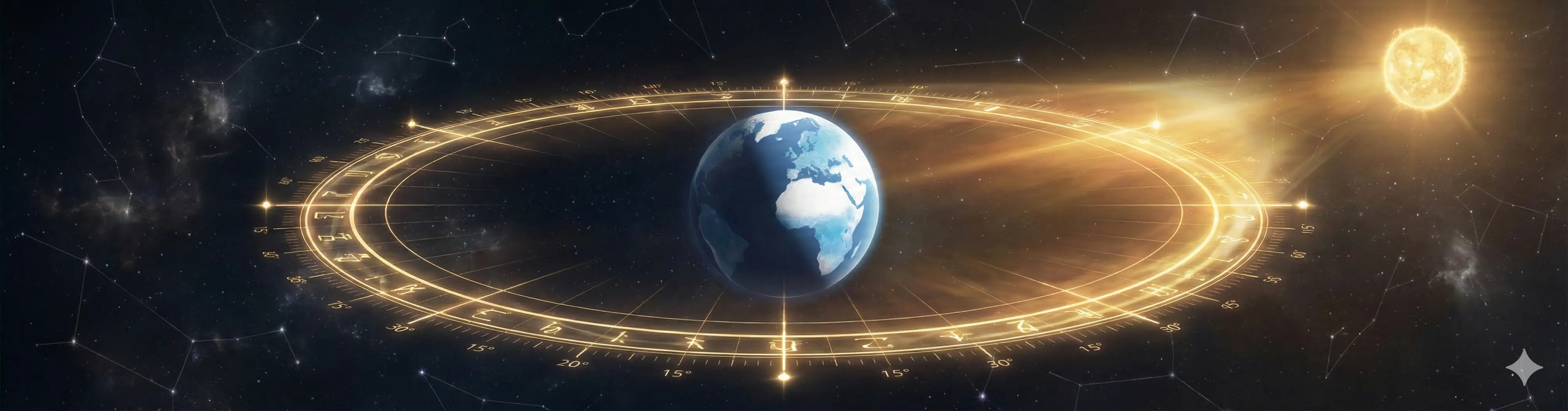
- Solar Terms as Ecliptic Degrees: The 24 Solar Terms are based on the Sun's position on the ecliptic (Solar Ecliptic Longitude), with every 15 degrees constituting a solar term. This is a quantifiable time scale based on the "Sun-Earth geometric relationship," rather than specific local temperatures or agricultural perceptions.
- Globally Consistent Coordinates: Solar Ecliptic Longitude is an angular parameter from a geocentric perspective. When the Sun is at the Vernal Equinox (0°) or Summer Solstice (90°), this astronomical phenomenon occurs simultaneously for any location globally. Therefore, determining the Month Command based on Ecliptic Longitude ensures objective consistency for charts worldwide.
Layered Thinking: The 'Li' (Principle) of Chart Determination vs. the 'Xiang' (Phenomenon) of Application
- Chart Determination (Principle) Does Not Change with Location: As the standard for the BaZi structure and the prosperity/decline of the Five Elements, the Month Command belongs to the level of "Principle" (Li). It must be based on the stable Solar Ecliptic Longitude and should not change due to geographic latitude or Southern Hemisphere climate.
- Manifestation (Phenomenon) Can Be Adapted to Context: The climatic difference in the Southern Hemisphere belongs to the level of "Phenomenon" (Xiang). When interpreting the subject's life experience or physical/mental sensations, the astrologer can incorporate local climate for interpretation, but this does not mean the basis of chart determination can be altered. Confusing the two will lead to methodological chaos.
Clarifying Common Misconceptions
- Solar Terms Are Not Designed Solely for the Northern Hemisphere: Solar Terms originate from the observation of the Sun's movement and are a globally universal geometric measurement. That the seasonal manifestations in the Southern Hemisphere are opposite does not equate to a difference in astronomical time coordinates.
- Month Command Should Not Be Defined by Heat or Cold: Seasonal temperature is a physical result on the Earth's surface, whereas BaZi requires a stable time scale. Altering the Month Command based on local climatic differences lacks justification.
- The Jia-Zi Sequence Cannot Be Arbitrarily Displaced: If the time sequence is converted by swapping (e.g., exchanging Jia-Zi and Jia-Wu), it will destroy the correspondence between the Gan-Zhi sequence and the astronomical Ecliptic Longitude, causing the logic of chart determination to collapse.
Practical Advice for Reading Charts in the Southern Hemisphere
- Adhere to Not Swapping the Month: When creating charts and performing basic analysis, explicitly state that the Month Command is based on the globally consistent Solar Ecliptic Longitude (Solar Terms).
- Annotate the Separation of Principle and Phenomenon: When explaining chart imagery, clarify to the client that "the Principle of Chart Determination" and "Surface Manifestation" are two different layers. If certain symbols manifest differently due to local climate, they should be noted as "empirical supplements" rather than replacing the foundation of chart determination.
The Month Command in ZiPing BaZi is built upon the Solar Ecliptic Longitude and the Earth-Sun geometric relationship. This standard possesses global consistency. To ensure consistency in chart determination and reading, one should not swap the month inversely based on the Southern Hemisphere's climate. Climatic differences in the Southern Hemisphere should serve as a reference for interpretation at the level of "Phenomenon," rather than altering the foundation of "Principle." Maintaining the stability of the "Principle" and the flexibility of the "Phenomenon" is the most robust approach for modern metaphysics facing globalization.